
Search Michigan Felony Records
Michigan felony records are held across several state systems, including the Michigan State Police Criminal Justice Information Center, county circuit courts, and the Department of Corrections. The Internet Criminal History Access Tool, known as ICHAT, is the main way to search felony records statewide. You can also look up offenders under state supervision through the OTIS database or check case records through MiCOURT. This guide covers all the key tools and sources for finding Michigan felony records.
Michigan Felony Records Overview
Where to Find Michigan Felony Records
Michigan uses several systems to track and store felony records. The Michigan State Police runs the Criminal Justice Information Center, which holds the central statewide repository of criminal history data. All felony arrests and convictions must be reported to this repository by law enforcement and courts across all 83 counties. Public access to this data comes through ICHAT, the Internet Criminal History Access Tool. ICHAT updates daily and covers felony arrests, convictions, and pending charges from every Michigan county. Circuit court clerks in each county also maintain complete case files for every felony case tried in their jurisdiction. These files are separate from the ICHAT database and often contain more detail.
The Michigan Department of Corrections runs a separate database called OTIS, the Offender Tracking Information System. This tracks people who are in prison, on parole, or on probation under MDOC supervision. OTIS is not a complete criminal history tool. It only shows people under active or recent MDOC oversight. For a full criminal history, ICHAT is the right starting point.
Court case records are a third key source. Michigan's statewide case portal, MiCOURT, lets you search felony cases by name or case number. Some counties also run their own local systems. Oakland County has Court Explorer. Wayne County has Odyssey Public Access. Ingham County has its own online record search. The Michigan Public Sex Offender Registry, maintained by the Michigan State Police, is a separate tool for looking up registered sex offenders by name, county, or zip code.
The Michigan Courts website at courts.michigan.gov provides access to the MiCOURT case search system, court forms, and a directory of all trial courts across the state.
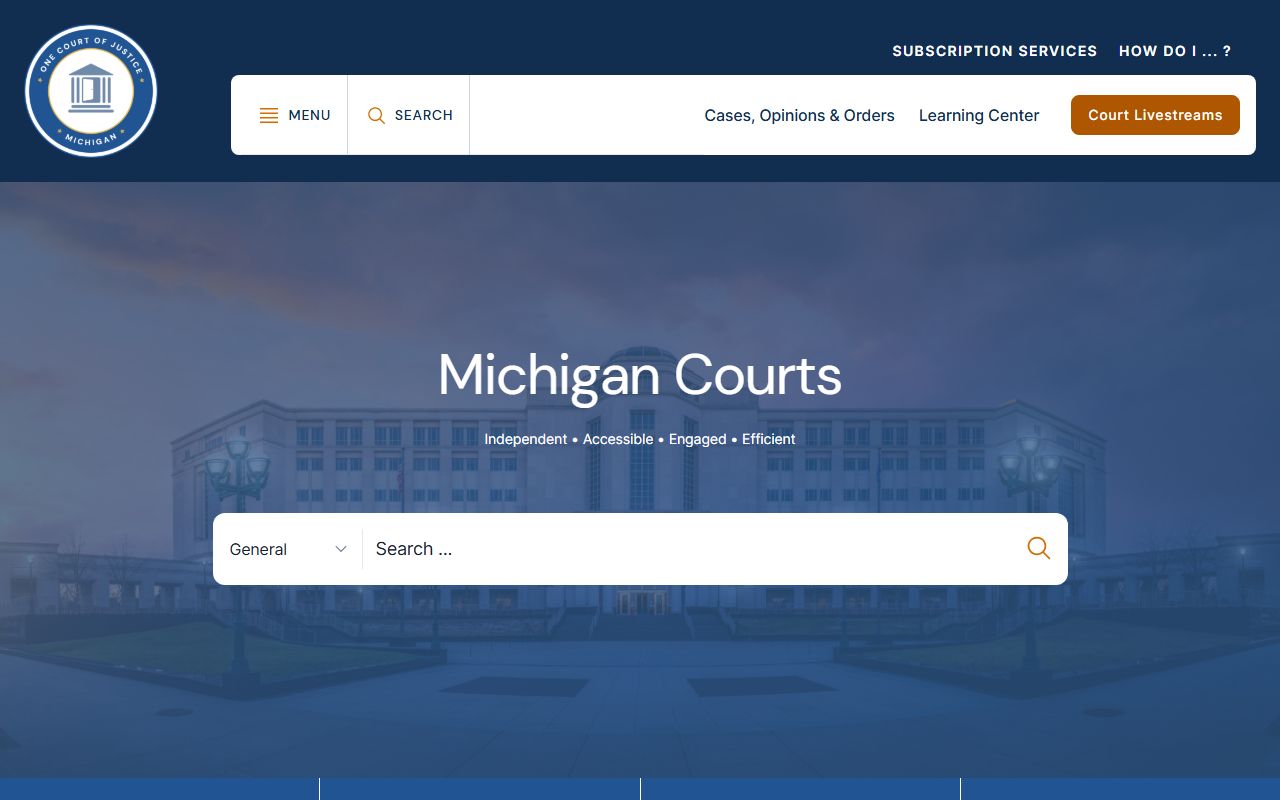
The site also links to individual county courts and specialty programs like drug courts and veterans treatment courts throughout Michigan.
Internet Criminal History Access Tool
ICHAT is the official online criminal history search portal maintained by the Michigan State Police. You can access it at apps.michigan.gov/ichat. The tool searches the CJIC's public repository, which draws data from all 83 counties. ICHAT shows felony arrests and convictions, serious misdemeanor convictions with penalties over 93 days, and pending felony charges. Each search costs $10 and requires a credit card. You must enter the person's full name and date of birth. Adding race and gender can help narrow results when names are common. The search returns a report showing the person's name, any known aliases, physical descriptors, and their full criminal history from Michigan courts. MCL 28.241 requires all Michigan law enforcement agencies and courts to report felony arrests and convictions to the CJIC within set timeframes. This reporting requirement makes ICHAT one of the most complete public access tools in the state.
ICHAT does not include everything. It will not show juvenile records, which are sealed. It does not include records from other states or from federal courts. Most traffic offenses do not appear unless they are serious, such as an OWI conviction. Records set aside under Michigan's Clean Slate law are removed from ICHAT results. ICHAT also does not show active warrants. For a fingerprint-based check, you submit an RI-008 fingerprint card with a $30 fee to the Michigan State Police Criminal Justice Information Center at 7150 Harris Drive, Dimondale, MI 48821. Fingerprint checks take 3 to 5 weeks to process. The Michigan State Police CJIC can be reached at 517-241-0606 or by email at MSP-CRD-ACCTHELP@michigan.gov.
The OTIS offender search tool at mdocweb.state.mi.us/otis2 lets you look up individuals under MDOC supervision by name, MDOC number, or physical description.
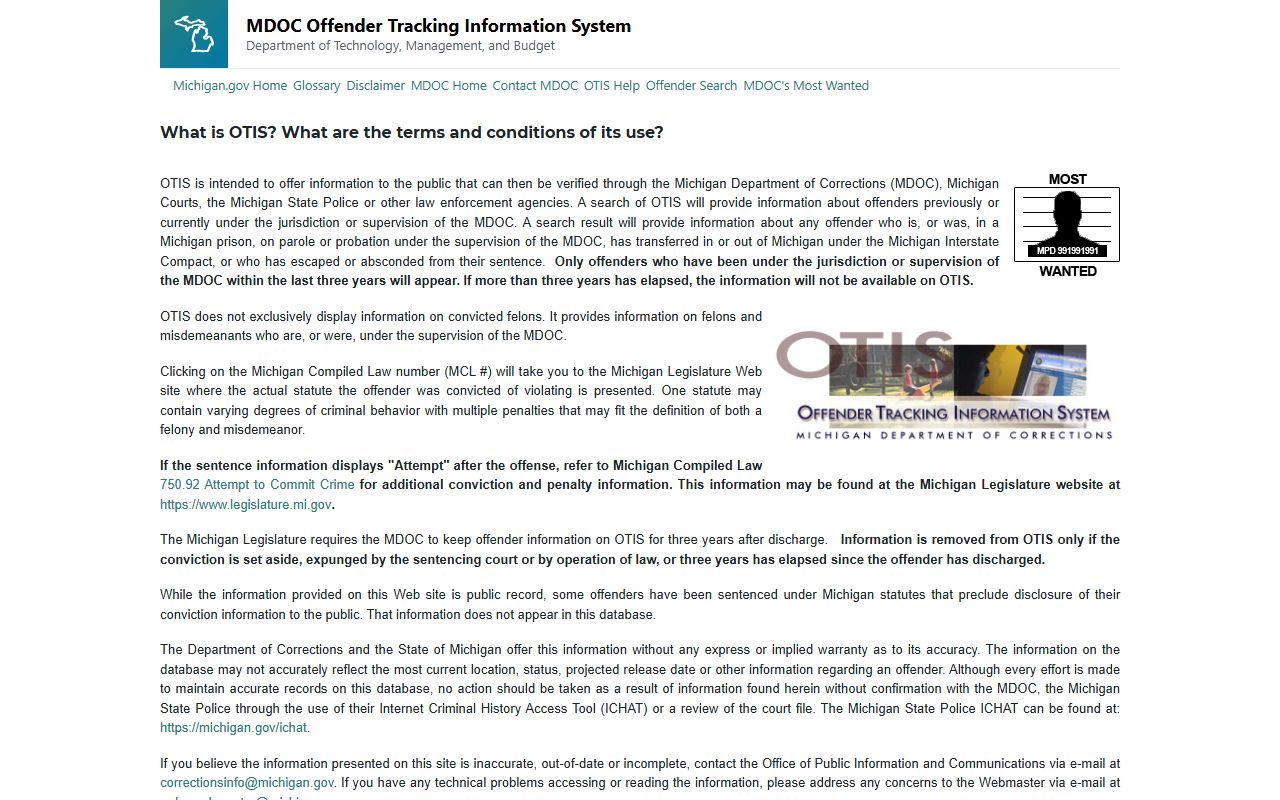
Search results show the offender's current status, facility or supervision location, and key sentence dates including the earliest release date and maximum discharge date.
OTIS Offender Tracking System
The Offender Tracking Information System (OTIS) is maintained by the Michigan Department of Corrections. OTIS shows information about individuals who are currently in prison, on parole, or on probation under MDOC supervision. You can search by last name, first name, or MDOC number. Results show the offender's name, date of birth, current status, facility or supervision location, the MCL number for the controlling offense, and sentence dates. Status codes include PRISON for incarcerated individuals, PAROLE for those released under community supervision, PROB for those on county probation supervised by MDOC, and DISCHRG for those who have completed their sentence. ABSCOND1 means the person is a parole absconder being actively sought by MDOC. OTIS also lists scars, marks, and tattoos on many profiles. You can also contact the department by email at correctionsinfo@michigan.gov.
OTIS removes data three years after the discharge date. It does not include county jail inmates unless they are under MDOC supervision. It is not a complete criminal history tool. Use ICHAT for a full felony record search.
The about page for OTIS at mdocweb.state.mi.us/otis2/aboutotis2.aspx explains all the status codes and data fields used in each offender profile.
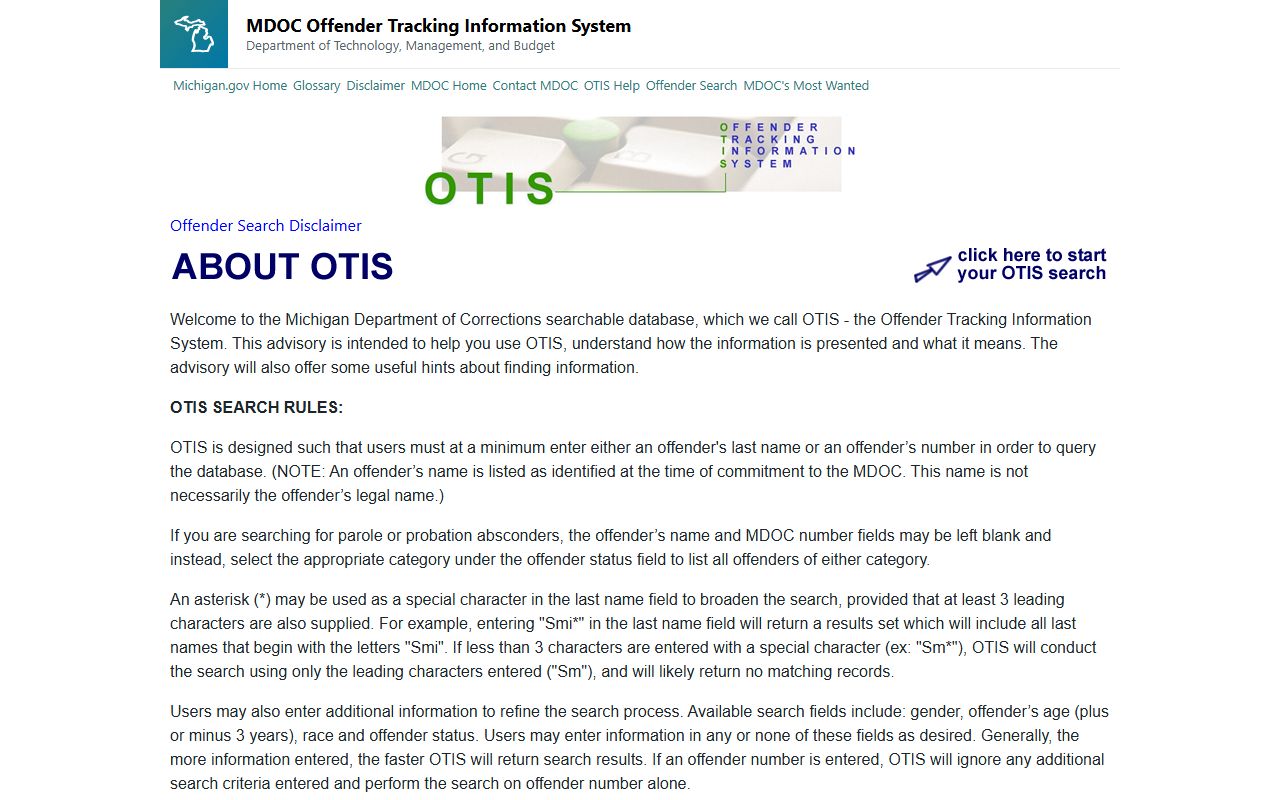
Understanding the status codes in OTIS helps you read search results correctly, especially the difference between DISCHRG, which means the sentence is complete, and active supervision statuses like PAROLE or PRISON.
What Michigan Felony Records Contain
A Michigan felony record spans several types of documents held in different places. The most complete source is the circuit court case file. These files hold the charging documents, which include the criminal complaint or information listing each charge and its MCL violation number. Arraignment records show the initial court appearance and the defendant's plea. Bond information, pretrial motions, and any plea agreements are also part of the file. The sentencing record is the key document. It shows the judgment of sentence listing the crime, the MCL citation, the sentence imposed, restitution ordered, and any probation conditions. The Presentence Investigation Report, required under MCL 771.14, gives background on the defendant including prior record, employment history, and substance use. All of these papers become part of the public court file unless sealed by court order.
ICHAT reports show specific data fields. Each entry includes the person's full name and any aliases, date of birth, physical descriptors, charge description, MCL number, date of offense, date of conviction, court of jurisdiction, and sentencing information. Pending charges also show up. The register of actions in a circuit court case file is a chronological log of every filing, hearing, and order in the case. You can request docket sheets without ordering full copies of documents. Full case files cost more and usually require an in-person visit or a mail request to the circuit court clerk.
Arrest records are a separate category. These are held by the arresting agency, usually a sheriff's office or local police department. Arrest records include the booking log, mug shot, and incident report. You request these through the agency's FOIA process. They are not automatically in ICHAT or MiCOURT.
Note: An ICHAT report reflects the criminal history in the state repository. It may not include arrests where no charges were filed, or convictions from other states or federal courts.
Michigan Expungement and Clean Slate Laws
Michigan's Clean Slate legislation, passed in 2020 and 2021, made major changes to the state's expungement process. Under MCL 780.621, individuals can petition to set aside up to three felony convictions. Only one of those three felonies may carry a maximum penalty of more than 10 years. The petition is filed using Form MC 227 at the court where the conviction occurred. There is no filing fee at the court, but a $50 processing fee is paid to the Michigan State Police. Fingerprints and certified copies of the conviction records are also required. The state police run a background check and report back to the court. A hearing is typically held 30 to 60 days after filing. If the court grants the petition, the conviction is removed from ICHAT and no longer appears in public searches. Form MC 227 is available from the Michigan Courts website at courts.michigan.gov. Michigan Legal Help at michiganlegalhelp.org has step-by-step guides on expungement eligibility and the petition process.
The automatic expungement law under MCL 780.621g goes further. It provides for automatic sealing of eligible felony convictions after 10 years and eligible misdemeanor convictions after 7 years. No petition is required. However, not all crimes qualify. Assaultive crimes, offenses with penalties of 10 or more years, and crimes involving minors or vulnerable adults are not eligible for automatic expungement. The Michigan Court Rules also govern access to records under MCR 8.119, which states that court records are public unless restricted by statute, court rule, or court order.
Note: Setting aside a conviction removes it from ICHAT results. It does not erase the underlying event. Certain licensing boards and law enforcement agencies may still see set-aside records in some circumstances.
Michigan FOIA and Public Access
Michigan's Freedom of Information Act, found at MCL 15.231 through 15.246, gives the public the right to request copies of government records. This includes police incident reports, arrest records, and agency correspondence related to felony cases. Under MCL 15.235, public bodies must respond within 5 business days, with a possible 10-day extension for complex requests. The first $20 of fees may be waived for individuals who show they cannot afford to pay. To request records from the Michigan State Police, you can submit through the MSP Records Request Portal online using MILogin, by email to MSPRecords@Michigan.gov, by fax to 517-241-1935, or by mail to Michigan State Police, Records Resource Section, P.O. Box 30634, Lansing, MI 48909. Copy fees are $0.10 per page. Active investigation records are generally exempt from public disclosure, and requesting parties may appeal denials under MCL 15.235.
Court records are open to the public under Michigan Court Rule 8.119. You do not need to state a reason for requesting them. Some records are restricted. Juvenile cases, adoption records, mental health proceedings, sealed cases, and records subject to protective orders are not available to the public. Personal information including Social Security numbers, driver's license numbers, and financial account numbers is redacted from copies provided to the public.
The Michigan Public Sex Offender Registry is accessible at michigan.gov/msp/services/sex-offender-registry and can be searched by name, city, county, or zip code.
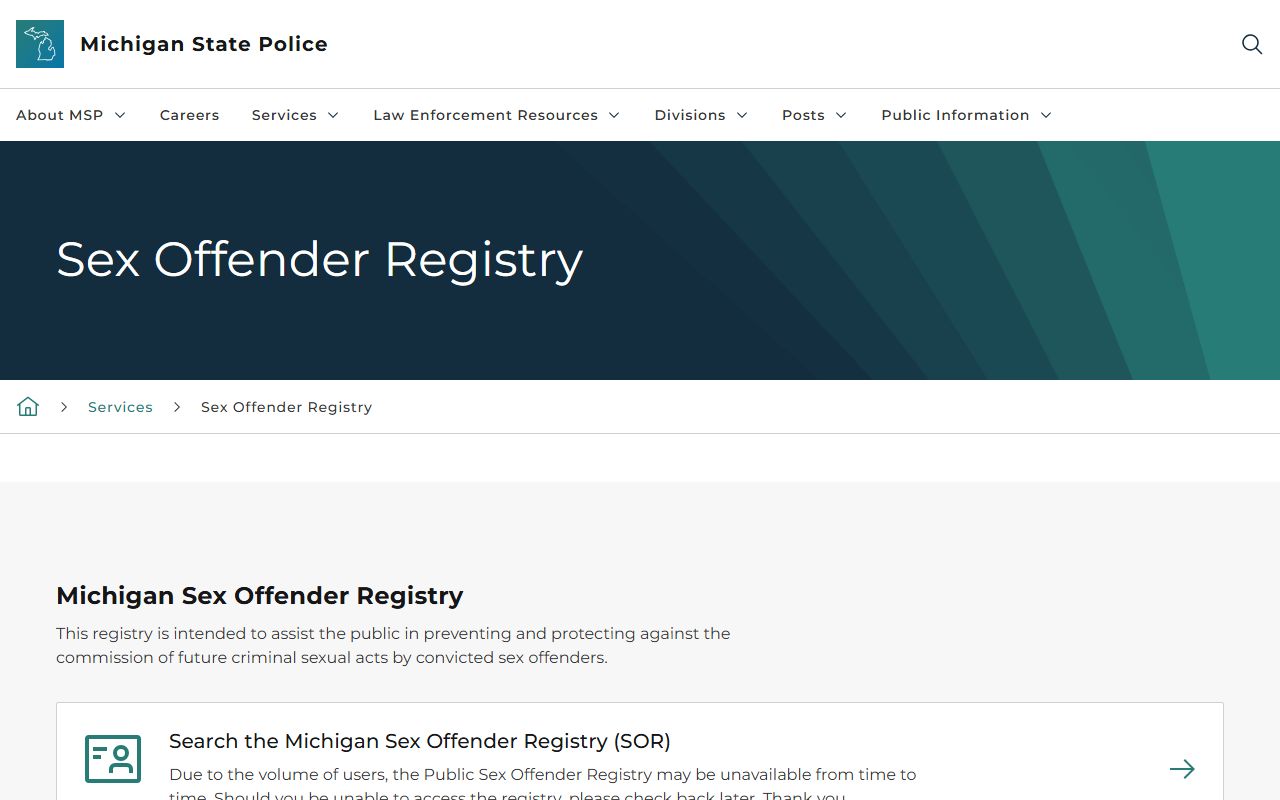
The registry lists tier 1, 2, and 3 sex offenders with photos, addresses, and the offense that triggered registration requirements under MCL 28.722, the Sex Offender Registration Act.
MiCOURT Case Search
MiCOURT is Michigan's statewide court case search system. You access it at micourt.courts.michigan.gov/case-search. The portal covers circuit courts and district courts across the state. You can search by case number, party name, attorney name, or business name. Results show case number, case name, case type, filing date, court, and case status. You can also pull up a register of actions showing the full history of filings and hearings in a case. MiCOURT is free to use for basic case lookups. It does not display document images. For full documents, you need to contact the court directly. Some courts also display records through their own local portals in addition to MiCOURT. MiCOURT does not display juvenile cases, adoption records, mental health proceedings, sealed cases, or Personal Protection Orders.
Several counties have their own online search tools worth knowing about. Oakland County's Court Explorer lets you search circuit, district, and probate court records by case number or name. Wayne County's Third Circuit Court provides access to the Odyssey Public Access portal for case lookups. Ingham County operates its own court record search covering criminal cases back to 2000. Allegan County has records available through the 48th Circuit Court. Macomb County uses CourtView for circuit court records, accessible at circuitcourt.macombgov.org. Kent County provides a court records search at kentcountymi.gov. These local tools can sometimes return results faster than MiCOURT for their specific jurisdictions.
Note: MiCOURT shows case information only. It is not an official background check tool and does not replace ICHAT for criminal history purposes.
Browse Michigan Felony Records by County
Each Michigan county has a circuit court that handles felony cases. The court clerk in each county maintains case files and records requests. Pick a county below to find local contact info, access options, and resources for felony records in that area.
Michigan Felony Records by City
Residents of major Michigan cities file felony cases at the circuit court for their county. Pick a city below for local courthouse info, district court details, and felony records access in that area.